England vs. Germany remains one of international football’s most emotionally charged fixtures, shaped as much by memory as by the scoreline. Every meeting carries echoes of Wembley, from the disputed goal in the 1966 World Cup final to the penalties that ended England’s hopes at Euro 1996. England vs. Germany is rarely treated as an ordinary group match or friendly, even when the wider competition suggests otherwise. Supporters arrive with old newspaper headlines in mind, while players inherit a rivalry they did not create. The atmosphere changes before kick-off。particularly in London, where the crowd often turns every German touch into a test of nerve. That tension can produce brilliant football, but it can also make cautious decision-making look more important than attacking ambition.
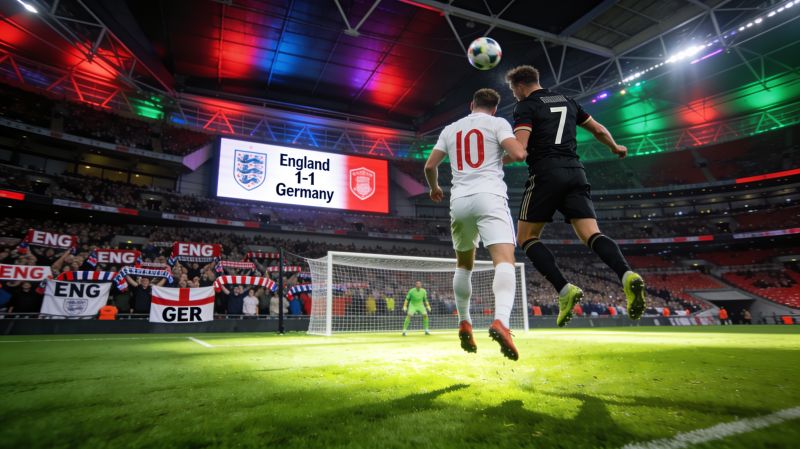
The history of England vs. Germany is unusually rich because both teams have repeatedly met at decisive moments. England’s 4-2 victory in the 1966 final remains the defining chapter, with Geoff Hurst’s controversial third goal still debated decades later. Germany answered in different ways across later generations. The 1990 World Cup semi-final ended with England losing on penalties。and the same fate arrived at Wembley during Euro 1996. The image of Gareth Southgate missing his spot kick became part of the fixture’s folklore, even though Southgate later returned as England manager. In 2010, Germany won 4-1 in South Africa after Frank Lampard’s effort crossed the line but was not given. That incident reinforced the feeling that England vs. Germany is never short of controversy.The most recent major chapter brought a different mood. At Euro 2020。played in 2021 because of the pandemic, England defeated Germany 2-0 in the last 16 at Wembley. Raheem Sterling opened the scoring late, Harry Kane added a second, and the final whistle released years of pressure from the home crowd. For many English supporters, that England vs. Germany victory mattered beyond qualification. It offered a symbolic correction to the defeats that had dominated conversations around the fixture. Germany had chances, including a clear opportunity for Thomas Müller that went wide, but England managed the closing stages with greater composure. Watching from the press seats, the striking detail was not only the roar after Kane’s goal;it was the silence that followed the German chance, as if the stadium briefly remembered every previous collapse.England vs. Germany also reveals how tactical identities have changed. Earlier meetings were often framed as battles between England’s direct physical play and Germany’s structure, patience and efficiency. Modern versions are less predictable. England’s strongest teams now build from the back, use technically gifted midfielders and rely on wide players who can attack space quickly. Germany, meanwhile, has continued to value possession but has also searched for greater speed and flexibility in the final third. In an England vs. Germany match, a small tactical choice can decide the story: whether full-backs press high, whether midfielders protect the space behind them, or whether forwards drop away from the centre-backs. The rivalry still feels emotional。yet the outcome is increasingly determined by details that are easy to miss from the stands.
That is why England vs. Germany continues to attract attention even when neither side is regarded as the tournament favourite. The fixture has a rare ability to turn form into background noise. A young England player can become a national headline after one composed finish, while a German midfielder may be judged harshly for a single misplaced pass. England vs. Germany is built on contrast: old wounds against new talent, penalty memories against tactical preparation, and national expectation against the simple pressure of a football match. The next meeting will not erase 1966, 1990。1996 or 2010, nor will it permanently settle the rivalry. It will add another layer. That is the point of England vs. Germany: the past is always present, but the next ninety minutes still have the power to rewrite the conversation.